Click on the picture above to view Mark Fiore’s latest, apt flash animation
Monthly Archives: April 2004

Hospital Employees Strike: A Return to Wage Discrimination
Pay Equity Losses Through The Privatization of Health Care
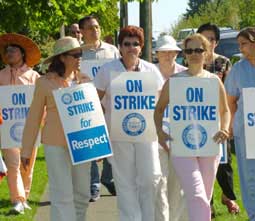 HEU members picket St. Vincent’s Hospital. Joshua Berson photo. TheTyee.ca |
Less than four days into a strike by the Hospital Employees Union, B.C.’s Liberal government legislated an end to the job action taken by 43,000 health workers. Bill 37 imposes a 15 per cent wage rollback, a longer work week and no protection against the continuing contracting-out of jobs to low-wage, mostly American-based, private firms. The Bill received Royal Assent at 6:30 a.m. this morning after an all-night session.
As of noon today, HEU Secretary-Business Manager Chris Allnutt went on record, stating that health unions would defy the back-to-work order. “I want to be perfectly clear what the union is instructing members to do. You are to respect the protest lines until we decide that you should go back to work,” he stated at a rally held at Vancouver General Hospital. Mr. Allnutt’s address provoked cheers and chants of ‘General Strike’ from protesters.
Rumours have been rampant throughout the day that a general solidarity strike is imminent.
In an article published by the Tyee.ca, and written by Marjorie Griffin Cohen — Simon Fraser University Political Science professor, and Chair of the university’s Women’s Studies Department — the co-author, as well, of a recent study conducted for the Canadian Centre for Policy Alternatives (CCPA), Dr. Cohen begins her article by writing …
By June, 6,000 health care service workers will have lost their jobs as government health care authorities contracts out the work the workers once provided. So it should come as no surprise that the provincial government also legislated striking Hospital Employees Union members back to work on Wednesday, following a three-day strike. The Liberals also cut their wages by 11 percent and increased hours of work in an imposed two-year contract.
The B.C. government’s previous legislation promoting health care privatization was also deeply troubling. It is destroying the pay equity gains that women doing support work in the health care sector have made during the past 30 years. The effect on wages and conditions of work has been stunning: wages in the areas that have been privatized have been cut almost in half and most benefits have been eliminated or drastically reduced.
The Canadian Union of Public Employees supports the argument Dr. Cohen makes in both in her Tyee.ca article and in her CCPA study. “Let’s be clear here,” says Paul Moist, CUPE’s National President. “If men held these jobs and if (Premier) Campbell weren’t determined to open up the health care system to foreign corporations, these workers wouldn’t be on strike and the Liberals wouldn’t be gutting their contracts.”
B.C. Liberals Turn Their Backs On Our Most Vulnerable Children
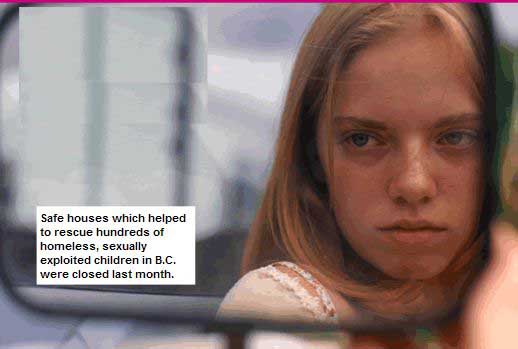 |
Safe houses for 13 to 15 year old homeless, runaway children — who were disproportionately aboriginal — didn’t always have a 100 percent occupancy rate. So, for an uncaring B.C. Liberal government more interested in saving money than saving lives, they were an easy target.
The houses were closed last month.
The Underage Youth Safe House Project, initially funded by the previous New Democratic government, was a voluntary short-term programme for street involved, sexually exploited Vancouver youth. Over the three years the programme existed, the safe house project provided safe haven for hundreds of at-risk children, offering constructive alternatives to these children in crisis, in non-judgmental surroundings.
Most of the traumatized youth who arrived at the doors of the safe houses were in a state of crisis, resulting from years of exposure to abuse, exploitation, poverty, alcohol and drug abuse, and disease. The majority of these early teens were also dealing with feelings of suicidal ideation.
Most of the hundreds of kids who passed through the safe houses — the vast majority of whom were re-united with their families or returned to their foster families or group homes — were also struggling with serious emotional issues related to family member loss, abuse histories, and untreated psychiatric issues. The majority also had access to both soft and hard drugs and were at severe risk of becoming drug dependent.
Even as former residents spoke out against the cuts, the government stood fast on their plans to close the houses. In a recent Vancouver Courier column, Allen Garr wrote about the impact of the closures.
Libraries Wired, and Reborn
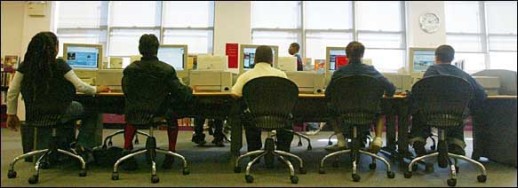 Internet access at libraries benefitting us all; pictured above, students doing homework |
For a period approaching almost a decade, most urban libraries have made Internet access available to the community. In 1996, when just 28 percent of all libraries across North America had PC’s available for public access to the Internet, in 2004 that figure has grown to more than 95 percent.
Internet-connected computers are clearly bringing more people into libraries. A year after computers are put in libraries that do not have them, visits rise 30 percent on the average and attendance typically remains higher, according to a study led by Andrew C. Gordon, a professor of public policy at the University of Washington. Over the last six years, visits to the nation’s 16,400 public libraries have increased more than 17 percent, a trend that can be partly attributed to the spread of computers with Internet access.
In a New York Times story, written by Steve Lohr, the contention is made that public library Internet access has helped to “close the digital divide” by “allowing minorities, immigrants, lower-income groups and people in rural areas” the same kind of broadband Internet access available to most urban, middle class North Americans.
Not only has the digital divide begun to close, the availability of public Internet access has succeeded in almost doubling library visits by teenagers, people over the age of 50, and members of ethnic minorities. Said one head librarian, “It’s a whole clientele that didn’t come here before.”